LOCAL REALITY FIELD NOTES / ASTRONOMY GEAR
Astronomy accessories explained: what you need and what can wait
A practical guide to telescope and stargazing accessories: finders, diagonals, eyepieces, Barlow lenses, red lights, dew control, filters and power supplies.
PRACTICAL BUYING GUIDE · UPDATED OCTOBER 14, 2026 · NOT A HANDS-ON PRODUCT TEST
See eyepieces and accessory examples ↗
Affiliate disclosure: this retailer link may earn Local Reality a commission at no extra cost to you. Illustrations are for orientation, not a claim that a specific product was tested.
This guide focuses on choosing equipment for a real observing goal, not chasing the biggest specification or the most expensive listing. I have not personally tested every product linked here. Verify exact specifications, compatibility, current stock, shipping, return terms and total cost with the manufacturer or seller before ordering.
Start with the problem, not the accessory
Accessories are useful when they solve a specific problem: finding a target, making the view comfortable, preventing dew, stabilizing a phone, or powering a tracking mount. They are not a substitute for a stable mount, clear sky, proper focus or compatible equipment. First use the items supplied with your telescope and note what is genuinely limiting your session.
Common accessories and what they do
| Accessory | Purpose | Buy/check when… |
|---|---|---|
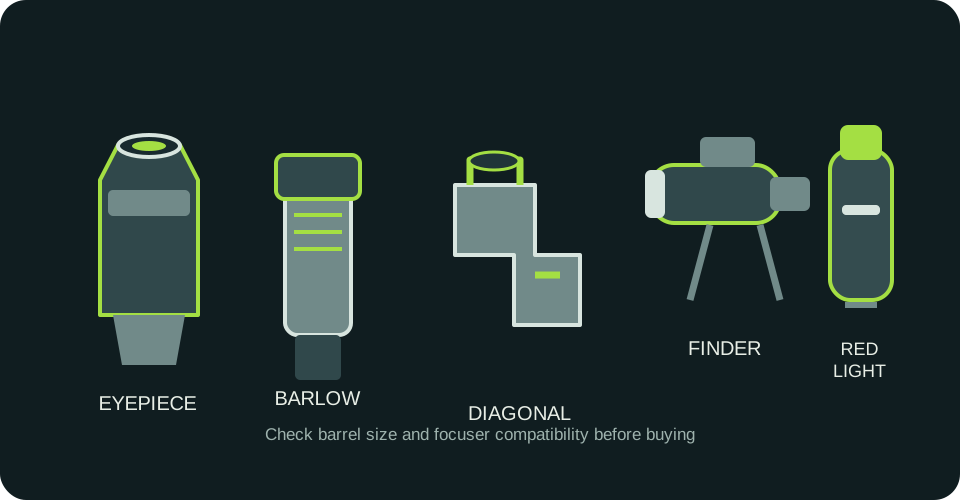
| Finder scope or red-dot finder | Helps aim the main telescope at a target. | Align it with the main optical tube; verify bracket compatibility and whether the finder suits your sky and targets. |
| Diagonal (refractor / compound scopes) | Redirects the light path to a more comfortable viewing angle; some designs also change image orientation. | Check optical design, barrel diameter and whether the telescope already includes one. A standard star diagonal does not make every view upright. |
| Eyepieces | Set magnification and affect field of view and eye comfort. | Calculate magnification and verify barrel size, field and eye relief. See our eyepiece guide. |
| Barlow lens | Increases effective magnification with a compatible eyepiece. | Buy only if the resulting power is useful; it cannot create detail the telescope or atmosphere cannot resolve. |
| Zoom eyepiece | Allows a range of focal lengths without swapping separate eyepieces. | Compare apparent field across the zoom range, eye relief, weight and optical quality. |
| Moon filter | Reduces brightness for more comfortable lunar viewing. | Optional for many observers; use a suitable astronomy filter only as directed. It is not a solar filter. |
| Light-pollution / nebula filters | Suppress selected wavelengths or background light to improve contrast on some targets. | Match the filter to target type, telescope aperture, sky conditions and the exact filter specification. They do not make light pollution disappear. |
| Dew shield / dew heater | Slows dew formation on exposed optics; heaters add controlled warmth. | Useful in damp or cooling conditions; check diameter, power draw and safe placement. |
| Red flashlight | Provides low-level light while helping preserve dark adaptation better than bright white light. | Choose adjustable low brightness. Red light is not invisible to dark-adapted eyes, so keep it dim. |
| Chair and observing list | Improve comfort and help you repeat a session. | Often among the cheapest upgrades; stable posture can make observing easier. |
| Phone adapter / tripod | Holds a phone steady for afocal photos through an eyepiece or wide-field night scenes. | Check phone/case width, eyepiece diameter, balance and whether the clamp can hold the phone securely. |
| Power supply | Powers computerized mounts, dew heaters and other electronics. | Match voltage, connector polarity, current capacity and runtime requirements exactly; never guess based on plug shape. |
What should a beginner buy first?
- Use the supplied eyepieces and finder; learn to align them.
- Get a dimmable red light, a comfortable seat and a plan for what to observe.
- Consider a second eyepiece only after identifying the useful magnification range you lack.
- Add dew control if condensation repeatedly ends sessions.
- Buy a phone adapter only if phone-through-eyepiece photography is a goal.
- For tracking equipment, verify electrical and mechanical compatibility before ordering.
Filters: useful, but often misunderstood
A nebula filter is designed to transmit selected wavelengths emitted by some nebulae while reducing other light. It will not improve every galaxy, cluster or planet; it may make stars dimmer, and performance varies with filter type, telescope aperture and sky background. A broadband filter cannot remove all city glow. Read the telescope filter guide before buying.
Compatibility checklist
- Exact telescope make, model and optical design.
- Focuser or diagonal barrel size (commonly 1.25 or 2 inches for eyepieces and filters, but confirm the manual).
- Thread type and diameter for filters or adapters.
- Clearance and balance: a heavy accessory can cause a small mount to slip.
- Power requirements for heaters or tracking equipment.
- Return policy if the manufacturer lists several variants that look alike.
Browse parts by category
These are retailer catalogs, not endorsements of every item. Compare exact model numbers and specifications before purchase.
Affiliate disclosure: Some retailer links on this site use a referral code. Local Reality may earn a commission from qualifying purchases at no additional cost to you. Affiliate relationships do not guarantee that an item is suitable; check the specifications and your own needs.
Start with binoculars vs. telescope ↗ · Binoculars buying guide ↗ · Telescope eyepieces explained ↗ · Plan a night with the gear you have ↗