FIELD NOTES / OCTOBER SKY
Orionid meteor shower 2026: when to watch and what to expect
The Orionids peak overnight October 21–22. This year, the useful question is not just when the shower peaks, but when the Moon stops washing out the fainter meteors.
BY MIKE BASSO · OCTOBER 18, 2026 · UPDATED FOR THE 2026 PEAK
The short answer
The Orionid meteor shower is active from October 2 through November 7, with its expected peak on the night of October 21 into the morning of October 22, 2026. NASA and the American Meteor Society describe a typical peak rate around 10–20 Orionids per hour under ideal dark-sky conditions. That is a broad benchmark, not a promise about what one person will see; local light pollution, clouds, the Moon, and plain meteor-to-meteor variability all matter.
This year's waxing gibbous Moon is bright enough to hide many faint meteors while it is above the horizon. For the Los Angeles area, Griffith Observatory's published 2026 table lists moonset at about 2:22 a.m. on the night of October 21–22. That makes the pre-dawn hours after moonset the most sensible window to consider, provided the sky is clear and morning twilight has not begun. Times vary with location and horizon, so check a local moonrise/moonset source for your exact observing area.
What are the Orionids?
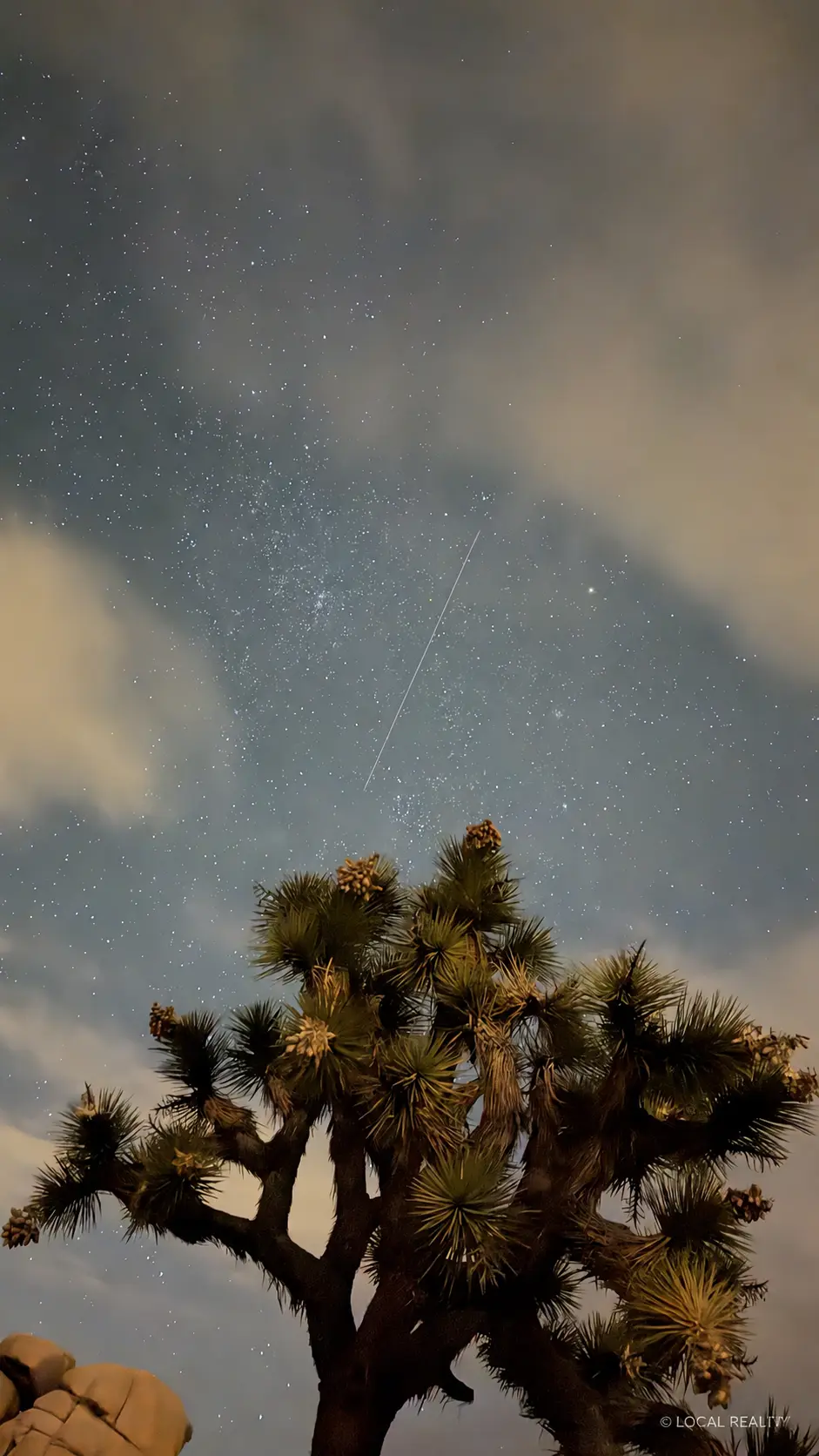
Earth passes through debris left by Halley's Comet. Tiny particles enter the atmosphere at roughly 66 kilometres per second (41 miles per second), heating the air and producing fast streaks of light. The meteors appear to radiate from a point near Orion, but a meteor can cross almost any part of the sky. You do not need a telescope or binoculars; looking through optics narrows your field of view and makes it easier to miss a streak.
A practical viewing plan
- Choose a place you are allowed to use after dark. Confirm current hours, closures, parking rules, and whether overnight access is permitted with the official land manager. A map pin or pullout is not proof that stopping there is legal.
- Check the forecast for the hours you will actually be outside. Clouds, wind, smoke, temperature, and road conditions can matter more than the calendar. Recheck alerts and the return route before leaving.
- Give yourself a wide view. Find an open patch of sky away from direct lights. You do not have to stare at Orion; look broadly across the sky and let your peripheral vision do some work.
- Get comfortable and wait. Bring a reclining chair or blanket where safe, warm layers, water, and a dim light for walking. Give your eyes time away from bright screens. A short session is still worthwhile if you learn what the sky looks like from your location.
- Set expectations honestly. You may see several meteors, a few, or none during a short stretch. A shower's theoretical rate assumes ideal conditions and an unobstructed view; it is not a personal hourly guarantee.
Is it worth driving out of Los Angeles?
Not automatically. Darker skies can make fainter meteors easier to notice, but a long drive is a poor trade if access is uncertain, wind is uncomfortable, smoke is present, or clouds are expected. Decide your minimum acceptable conditions first. If the forecast is marginal, observe from a permitted nearby place, choose a different night during the shower's active period, or make the evening a Moon-and-planet session instead.
Use the free Local Reality night planner to organize research leads, weather checks, Moon timing, and a packing brief. The planner is a research aid: it does not guarantee a clear sky, confirm legal access, or replace official closure and road information. For general planning, see Moon or Milky Way? and the printable field sheet.
Can you photograph the Orionids?
It is possible, but meteor photography is a matter of patience and many frames. A camera on a stable tripod with a wide lens can record a large portion of the sky; a phone may capture bright meteors in some modes, but it is not guaranteed. Keep the framing wide, use a timer or remote shutter if available, and avoid changing settings after every frame. Most individual exposures will contain no meteor, even if activity is good. Do not handle gear or stand near traffic in darkness to chase a shot.
If you are new to night photography, start with our first night-sky photo troubleshooting guide or smartphone astrophotography workflow. A stable, focused test image is a useful result even without a meteor.
After the peak
The Orionids remain active through November 7, although activity is not expected to be evenly distributed across every night. If October 21–22 is cloudy or inconvenient, check a current meteor calendar and local forecast rather than assuming the shower ends after its peak. The next prominent shower peaks are the Southern Taurids on November 4–5 and the Leonids on November 16–17, 2026; their sky conditions will differ.
Sources and further reading
- NASA Science: Orionids meteor shower
- NASA: October 2026 skywatching tips
- American Meteor Society: 2026–2027 meteor shower calendar
- Griffith Observatory: 2026 Moonrise and Moonset table
Dates and approximate Los Angeles-area moonset timing are based on the linked published sources. Recheck them and local conditions near the time of observing. These sources do not endorse Local Reality.