LOCAL REALITY FIELD NOTES / ASTRONOMY GEAR
Telescope buying guide for beginners: types, aperture and mounts
A practical beginner telescope buying guide: compare refractors, reflectors, compound telescopes, aperture, focal ratio, mounts and realistic costs.
PRACTICAL BUYING GUIDE · UPDATED OCTOBER 14, 2026 · NOT A HANDS-ON PRODUCT TEST
Browse telescope options and current gear ↗
Affiliate disclosure: this retailer link may earn Local Reality a commission at no extra cost to you. Illustrations are for orientation, not a claim that a specific product was tested.
This guide focuses on choosing equipment for a real observing goal, not chasing the biggest specification or the most expensive listing. I have not personally tested every product linked here. Verify exact specifications, compatibility, current stock, shipping, return terms and total cost with the manufacturer or seller before ordering.
Quick answer: buy for your main target and your patience
There is no single best beginner telescope. For a first visual instrument, compare a stable mount and useful aperture before paying extra for computerized pointing or a long list of included accessories. If possible, attend a public observing night and try different designs before choosing.
What the telescope types actually do
| Design | How it works | Common strengths | Tradeoffs to check |
|---|---|---|---|
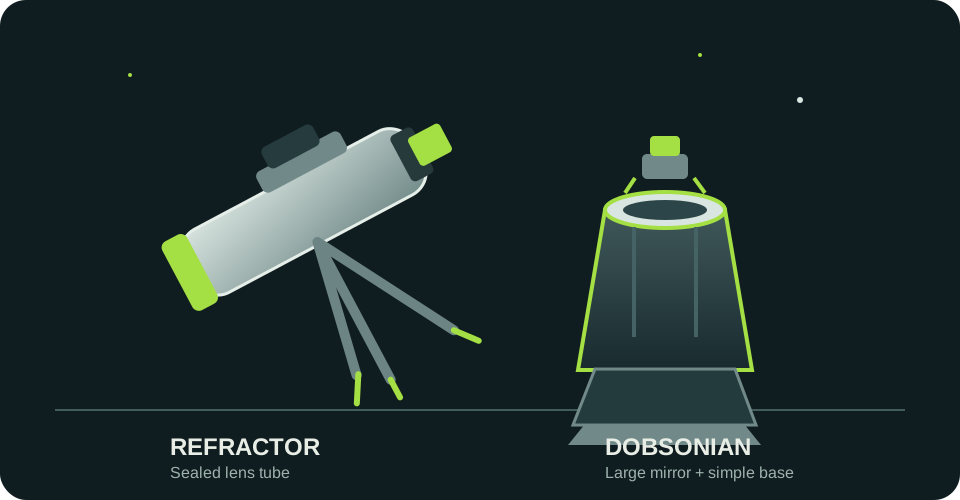
| Refractor | A front lens bends and focuses incoming light. | Often quick to set up; many small models need little routine optical adjustment. | Good color correction and aperture can cost more; inexpensive short refractors may show color fringing on bright targets. |
| Newtonian reflector | A curved primary mirror focuses light; a secondary mirror directs it to the eyepiece. | Often offers substantial aperture for the price; good for Moon, planets and deep-sky visual observing. | May need collimation checks; open tube can collect dust and requires sensible storage. |
| Compound / catadioptric | Mirrors and a correcting lens or plate fold the optical path into a compact tube. | Compact for its focal length; versatile for lunar and planetary viewing. | Can cost more per aperture; some designs need thermal acclimation and a suitable mount. |
Aperture: the specification that matters most for visual use
Aperture is the diameter of the main lens or mirror. More aperture collects more light and can resolve finer detail when the atmosphere, optics and focus allow it. It does not guarantee a sharper view on every night. Bigger instruments are also heavier, bulkier and slower to transport or cool to outdoor temperature.
Do not confuse aperture with magnification. A small telescope at very high power does not reveal detail it cannot resolve; the image simply becomes larger, dimmer and often softer.
Focal length and focal ratio, without the jargon
Focal length is the effective distance over which the telescope brings light to focus. It helps determine magnification with a given eyepiece. Focal ratio is focal length divided by aperture, using the same units. A shorter focal ratio generally makes it easier to get a wider field with a given eyepiece and is often useful for extended deep-sky views; a longer focal ratio can make high magnification easier to reach with comfortable eyepieces. Neither ratio alone tells you the overall quality.
The mount is half the experience
- Alt-azimuth: moves up/down and left/right. Often intuitive and quick for visual observing.
- Dobsonian: a Newtonian tube on a simple rocker-style alt-azimuth base. Often a cost-effective visual setup with substantial aperture.
- Equatorial: one axis can be aligned with Earth's rotation axis. Useful for tracking, but setup and alignment take learning; long-exposure imaging usually needs a properly aligned, motorized tracking system.
- Go-to/computerized: helps locate targets after correct setup and alignment. It does not remove the need to level, align, power and learn the system.
A shaky mount can ruin an otherwise capable optical tube. Assess the full kit: tripod or base, focuser, finder, eyepieces, power needs, packed dimensions and whether you can comfortably move it.
What can you expect to see?
The Moon shows obvious craters and shadows even in modest instruments. Jupiter can show its four large moons and, under suitable conditions, cloud bands. Saturn's rings can be visible in a well-focused telescope when Saturn is suitably placed. Star clusters and brighter nebulae benefit from dark skies; many galaxies remain faint smudges visually, even in large amateur telescopes. Photos often show more color and structure than the eye sees through an eyepiece.
Visual astronomy versus astrophotography
Do not assume a telescope designed for pleasing visual use is automatically the easiest imaging rig. Long-exposure deep-sky imaging typically needs tracking, accurate alignment, focus control and processing. Planetary and lunar imaging have different requirements. Decide whether your priority is looking through an eyepiece, taking phone snapshots of the Moon, or making tracked deep-sky images.
Before ordering: a ten-point check
- Set a total budget for the entire working setup, not just the tube.
- Measure where it will be stored and how it will be transported.
- Identify your first three targets.
- Check the mount's stability and payload suitability for the actual optical tube.
- Confirm focuser and eyepiece barrel sizes.
- Check whether a finder, diagonal, eyepieces and tripod/base are included.
- Find out whether the design requires collimation, batteries or external power.
- Check whether the telescope will fit through doors and into your car.
- Read the seller's return and warranty terms.
- Ignore unsupported claims of extreme maximum magnification.
Accessories and catalogs
Learn the supplied eyepiece before upgrading. If you need to compare parts, use the eyepiece guide and the mount guide first.
Affiliate disclosure: Some retailer links on this site use a referral code. Local Reality may earn a commission from qualifying purchases at no additional cost to you. Affiliate relationships do not guarantee that an item is suitable; check the specifications and your own needs.
Start with binoculars vs. telescope ↗ · Binoculars buying guide ↗ · Telescope eyepieces explained ↗ · Plan a night with the gear you have ↗